

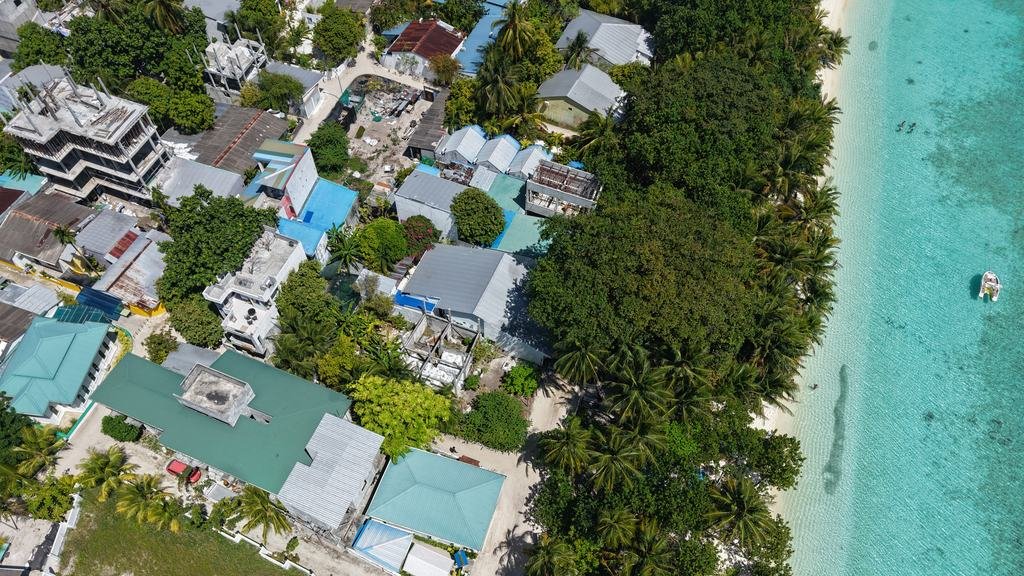
They are genuinely different holidays and neither is better in general. A small guesthouse gives you fewer people, one point of contact and a house rather than a lobby. A larger property gives you facilities, choice, staff cover and the ability to be anonymous.
We run a three-room guesthouse, so you know where we sit. That is exactly why the case for the larger place is worth making properly.
What actually differs
Not atmosphere. Six practical things.
- Who you deal with.
- At three rooms, one person handles your booking, your boat, your excursion and your bill. At thirty, those are usually different people or different systems.
- Whether anyone is on duty at 11pm.
- A larger property has shifts and cover. A very small one has a person who is around, which is not the same as a person who is on a rota.
- What is on site.
- Restaurant, pool, spa, dive centre, more than one room category. Below a certain size, none of that exists. You use the island instead.
- How much you are noticed.
- At nine guests you are known by the second morning. Some people find that the best part of the trip and some find it exhausting. There is no right answer and it is worth knowing which you are.
- What happens when something goes wrong.
- Small places tend to fix things personally and fast; larger ones have procedures and backup. Both work. They fail differently.
- What you pay for.
- Facilities cost money to run and that shows in the rate. If you will not use the pool, you are still contributing to it.
When the larger hotel is the better choice
Genuinely, and more often than a page like this usually admits.
- You want facilities without leaving.
- A pool matters more than people expect in the middle of the day, when the sun is high and the beach is uncomfortable. So does a restaurant you can walk to in a towel. Small guesthouses rarely have either.
- You want privacy.
- Some people are on holiday to not be known. At a property where the host learns your plans, that is harder. At thirty rooms you can be pleasant at breakfast and invisible the rest of the day.
- You are travelling as a group.
- More rooms, more room types, and the ability to put six people in the same building without taking over the whole place.
- You want choice on site.
- More than one place to eat, more than one thing to do, without going out.
- You want the reassurance of scale.
- More reviews, more established procedures, more staff. For a first Maldives trip, or a first local-island trip, that is a reasonable thing to want.
- Your dates are inflexible.
- Three rooms sell out. Thirty rooms have availability.
- You are travelling with a specific need.
- Accessibility, dietary requirements, small children, medical considerations. A larger operation is more likely to have handled it before and to have the staff to handle it again.
When the small guesthouse is the better choice
- You want one person to arrange everything.
- This is the biggest practical difference and the least visible one in advance. At a small property, the person who books your room also books your boat, watches the weather for your excursion and knows your flight is delayed. There is one conversation instead of four, and nothing falls between two systems.
- You want the local knowledge to be first-hand.
- At a small guesthouse the person telling you where to snorkel usually swims there. Larger properties employ excellent staff, but there is often a layer between you and the water.
- You want quiet common areas.
- Nine guests do not make noise. A busy breakfast room does.
- You would rather eat on the island.
- If a property has no restaurant, you eat where the island eats. On an island with a decent food scene that is an upgrade, not a compromise.
- You want flexibility more than process.
- Breakfast slightly early because of a boat, an excursion moved to a better morning, luggage kept after check-out. Small places say yes to these because there is nobody to ask.
- You dislike being processed.
- No check-in queue, no wristband, no lanyard, no buffet.
The honest disadvantages of small
Because a page arguing only one way is not worth reading.
- Fewer reviews.
- A three-room property that opened recently has a short history. That is a real information problem for someone booking from a distance, and “we are small” does not fix it. Look at what the reviews say rather than how many there are, and ask the property directly how long it has been open.
- No cover if the one person is unavailable.
- Illness, a family event, a day off the island. Larger properties have a rota.
- Sold out is sold out.
- No moving you to a different room type.
- No facilities.
- No pool, no spa, no on-site restaurant. If a bad-weather afternoon with nothing to do sounds grim, that is a genuine consideration.
- Less anonymity.
- Covered above, and it cuts both ways.
- Less recourse.
- A larger business has more formal complaint routes. With a small one, if the relationship goes wrong there is nowhere else to take it.
The questions that tell you what you are booking
Room count does not tell you enough on its own. These do.
- How many rooms, and how many guests at maximum? Rooms alone can mislead.
- Who arranges the airport transfer, and who arranges excursions? One name or several tells you how the stay will run.
- Is there anyone available in the evening?
- Is breakfast included, and where is it served? A garden is different from a dining room, which is different from a tray.
- What is on site, and what requires going out?
- How long have you been open? Not a criticism — context for the reviews.
- If my flight is delayed, who do I contact? The answer reveals the whole operating model.
What size does not decide
Worth saying, because size is easy to compare and therefore gets over-weighted.
It does not decide cleanliness. It does not decide whether the air conditioning works. It does not decide whether the reef is good; that is the island. It does not decide whether the excursion is well run, because on most local islands the boats are operated by separate companies that both a three-room guesthouse and a thirty-room hotel book you onto.
And it does not decide whether the people are kind. Every size of property has both.
So which?
Choose the larger hotel if you want facilities on site, privacy, more choice, the reassurance of scale, or you are travelling as a group or with a specific need.
Choose the small guesthouse if you want one person handling everything, first-hand local knowledge, quiet, flexibility, and a stay that feels like staying in a house rather than checking into a building.
If you cannot decide, ask both the seven questions above. The answers will separate them faster than the room count did.
Frequently asked questions
Is a guesthouse the same as a small hotel in the Maldives?
Not necessarily. “Guesthouse” covers everything from three rooms to thirty on local islands, and the licensing category does not tell you the experience. Ask for the room count and the maximum number of guests.
Are small guesthouses better for excursions?
They are often better at arranging them, because one person handles it and knows the operators personally. The trips themselves are usually run by the same independent boat companies either way.
Is it awkward staying somewhere with only a few guests?
For some people, yes, and it is worth being honest with yourself about it. You will be recognised, greeted and asked how your day was. Most people like it. If you would find it intrusive, book somewhere larger.
What if a small guesthouse has very few reviews?
Check how long it has been open. A new property with twenty reviews and an established one with twenty are very different signals. Read what the reviews say about the specific things you care about.
Can a small guesthouse handle a family?
Often yes, but ask about room capacity, bed arrangements and whether excursions suit children's ages before booking, rather than after.
Do small guesthouses cost less?
Not reliably. They have fewer facilities to fund, but also fewer rooms to spread fixed costs across. Compare total trip cost rather than nightly rate. How to compare properly.
Where we sit
Madi Maldives has three rooms and never more than nine guests. We opened in 2025, so the building is new and our review history is short. Both are worth knowing when you compare us against a place with four hundred reviews.
Ahmed Farooq, who hosts, was born on Ukulhas and has been in this water since he was a child. When we tell you which morning to go looking for manta rays, that is not something we read. Knowing where to look is not the same as a promise, and sightings are never guaranteed.
There is no pool, no spa and no restaurant. Breakfast is in the garden and dinner is on the island, which has around a dozen restaurants a few minutes' walk away. Everything else — your room, both speedboat journeys, one morning out on the water — comes as one price, from $680 for two.
Total package price for two adults. Includes all applicable taxes and service charges.
If that reads like the wrong holiday, the larger hotel down the road is a good one. Book it with confidence.